


Four quarters. That is how long it took us to go from a $1M run rate to $100M. This year alone, we grew 37.5x. I keep staring at those numbers. They still do not feel real.
Checking our projected run rate every morning has become an addiction. Ten days into October, it was already showing $100M. I knew it was a projection. I knew there was still a real chance we wouldn’t finish the month there. But we had rebuilt this company with a few months of runway left, and now I was looking at that number. Out of excitement I took a screenshot and sent it to the board and the team.
We did not set out to race a chart. We set out to give AI agents a real computer. Somewhere they could write code, use tools, make mistakes, and keep working. The number is just what showed up when that need became obvious to enough people at once.
A new pace
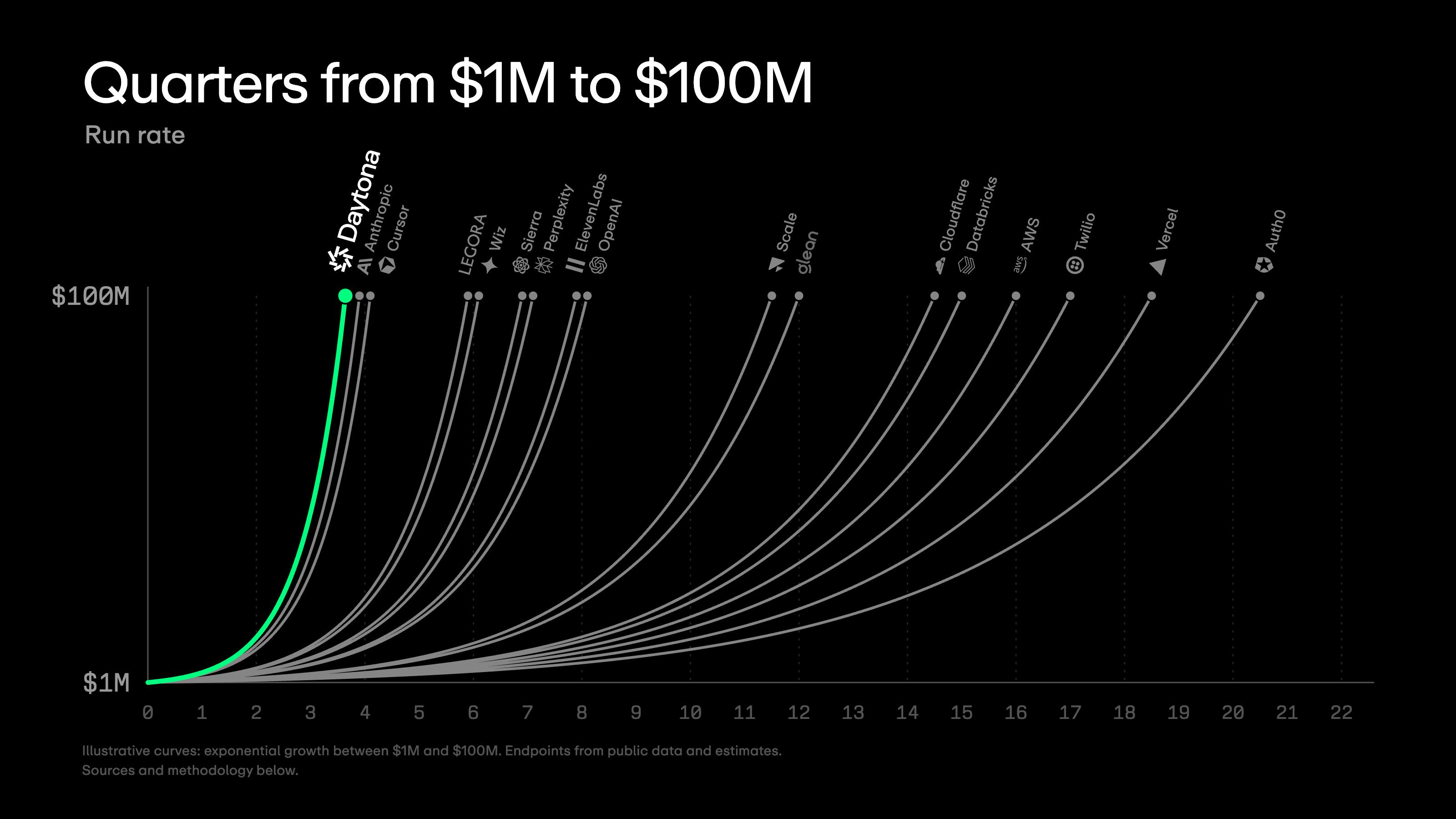
If you have been in software for a while, $1M to $100M used to be a multi-year climb. ICONIQ's research puts the old playbook in plain numbers: software companies used to take five or more years to cross that stretch. Their 2026 State of Scaling report shows AI-native companies reaching $100M ARR in one to three years.
Look at who else is on that curve.
Anthropic went from essentially zero to $100M in annualized revenue in 2023, in about a year. Cursor went from $1M to $100M ARR in roughly 12 months. Mercor crossed $100M 11 months after $1M. Legora and Wiz each did it in about 18 months. Sierra hit $100M ARR seven quarters after launch. Perplexity and ElevenLabs each took about 20 months, measured from Perplexity's paid launch and ElevenLabs' product launch. Glean got there in about three years.
Put us on that same chart and we land next to Anthropic, just under four quarters. I do not say that lightly. Anthropic has been the clearest example of how fast a company can scale in this era. Sharing a lane with them on this one metric is humbling more than it is loud.
Why it happened
The short version: agents need somewhere to run.
Models think on GPUs. Work happens on CPUs. Every time an agent writes code, opens a browser, installs a package, or forks a long-running job, it needs a machine; isolated, fast, stateful, and available through an API. The cloud we already had was built for human-shaped workloads: start a VM, wait, run the same thing the same way. Agents do not work like that. They spin up thousands of environments. They pause and resume. They explore branches in parallel. They need startup in tens of milliseconds, not minutes.
We learned that the hard way.
Daytona started as automated development environments for human engineers. Then agents showed up, and the customers we talked to were blunt: what we had was not what they needed. So we did the scary thing. We handed our old customers to competitors, rebuilt from first principles, and relaunched with a few months of runway left.
What came back was an unmistakable pull. People building agents did not want a demo box. They wanted a real computer for every agent: code execution, computer use, reinforcement learning, the messy stuff in between. This is what Daytona is, an Agent Execution Cloud. Instantaneous startup times, state that persists. Forks and snapshots. Per-second billing that matches how agents actually use compute.
What it felt like
It did not feel like a victory lap. Most days it felt like trying to keep the floor from collapsing under the people who trusted us.
Capacity. Support. Hiring. Explaining to investors why agents need a different cloud than the one they already knew. Watching RL and eval traffic go from almost nothing to a huge share of usage, with square-wave spikes that no classical capacity model was designed for. Being in too many Slack Connect channels at once. Saying yes when a customer needed a huddle in five minutes.
I am grateful in a way that is hard to perform on a blog. Grateful to Vedran and Goran, who have built with me across multiple lives of this company. Grateful to a team that answers at odd hours because that is the culture we chose, not a slide. Grateful to the early customers who asked for API keys before we had a login page, and to the ones who stayed while we tore the product down and put it back together. Grateful to FirstMark, Pace, Upfront, and the angels who believed when the thesis was still mostly a trajectory.
And grateful to the builders shipping agents on top of us, from YC companies to labs and Fortune-scale teams. You are why the chart bends.
What comes next
A run rate is not a destination. The number means customers found something useful. It does not mean the hard part is over.
We have to keep the trust of the users we have and earn the trust of those we do not. Models will keep getting better. The bottleneck moves to the computer underneath. Every agent that can think still needs a place to work.
That is the job. Keep the computers fast. Keep them safe. Keep them elastic enough for a world where the number of agents is measured in numbers that still sound ridiculous when you say them out loud.
To everyone who got us here: thank you. We will not waste it.
— Ivan
Try Daytona
Create isolated sandboxes, run untrusted code safely, and connect agent workflows to the tools they need.
Sources
Anthropic (1, 2) · Cursor (1, 2) · Mercor (1, 2) · Legora (1, 2) · Wiz (1, 2) · Sierra (1, 2) · Perplexity (1, 2) · ElevenLabs (1, 2) · OpenAI (1) · Glean (1, 2) · ScaleAI (1, 2, 3) · Cloudflare (1, 2, 3) · Databricks (1, 2) · AWS (1, 2, 3) · Twilio (1, 2) · Vercel (1, 2) · Auth0 (1, 2, 3)

