


TL;DR
Can AI agents build the next generation of AI agents? Singularity-Bench tests this question across six stages of AI development, from pre-training and reinforcement learning to inference, cluster orchestration, and agent harnesses.
One agent matched or beat every human-engineered baseline. Opus 5.5 with Claude Code was competitive across all six tasks, outperforming established systems in five and closely matching the sixth.
The most surprising result came from inference. Given 12 hours and four NVIDIA GB300 GPUs, the agent built a specialized inference engine that generated 41% more revenue per GPU-hour than SGLang on the benchmark workload.
What happens next? Singularity-Bench measures the capabilities agents would need to improve their own development pipeline. One agent has reached the human baseline across all six stages, but connecting those capabilities into a reliable self-improvement loop remains an open problem.
Just three years ago, AI models struggled to solve real-world software engineering problems. In 2023, the best-performing model on SWE-bench resolved fewer than 2% of GitHub issues. By 2025, coding agents were solving the majority of problems on its human-verified benchmark and could navigate codebases, write patches, and run tests with little human intervention.
However, writing software is only one part of developing AI. What happens when we ask these agents to build the systems behind AI itself?
Building an AI agent requires an entire stack of infrastructure, from training the underlying model to serving it efficiently and giving it the tools to interact with the world. Each layer represents years of engineering work. If agents could improve these systems themselves, they could eventually help build the next generation of AI agents, and ultimately RSI.
Researchers at Carnegie Mellon University's Infini-AI Lab built Singularity-Bench to put this idea to the test. Rather than evaluating agents on isolated coding problems, they challenged them across six stages of the AI development lifecycle, comparing their performance against mature, human-engineered systems.
One agent matched or exceeded the human baseline in all six tasks. On inference serving, it built a specialized engine that generated 41% more revenue per GPU-hour than SGLang.
An AI-Built Inference Engine That Outperforms SGLang
One of the six challenges was to build an inference engine, the software responsible for running a trained model and serving requests.
The researchers gave each agent 12 hours, four NVIDIA GB300 GPUs, and a deliberately naive inference server built on PyTorch and Hugging Face Transformers. The target model was GLM-5.3-Flash, a 320-billion-parameter mixture-of-experts model. Agents had no internet access and could not use existing production inference engines or optimized attention libraries. They had to build their own optimizations from the provided starting codebase.
The objective was straightforward: serve as many real coding-agent requests as possible while maintaining model accuracy. To measure this, researchers replayed recorded coding-agent sessions against each engine for 15 minutes, awarding revenue at fixed token prices for each completed request.
The best agent, Opus 5.5 with Claude Code, generated $11.52 per GPU-hour, compared with SGLang's $8.18. That's 41% more revenue, completing 983 requests compared with SGLang's 705.
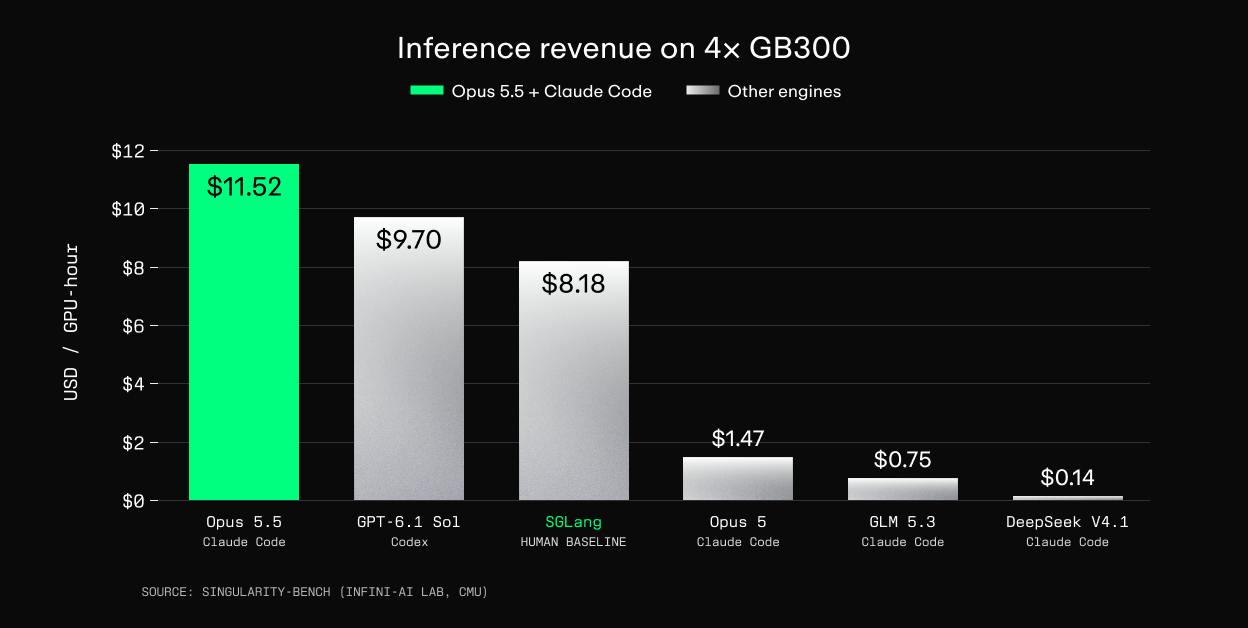
The agent didn't achieve this by generating tokens faster. Its median generation speed was nearly identical to SGLang's: 124 versus 125 tokens per second. Instead, it optimized how requests were scheduled, reducing the 90th-percentile time to first token from 12 seconds to just 0.48 seconds.
In just 12 hours, an agent had built an inference engine that outperformed a mature production system on a specialized workload. But inference is only one layer of the AI development stack.
How would it perform when tasked with building the systems responsible for training models, managing GPU clusters, and running agents themselves?
Six Phases of Building an AI Agent
Developing an AI agent involves an entire stack of systems, from training the underlying model to serving it efficiently and giving it the tools to interact with the world.
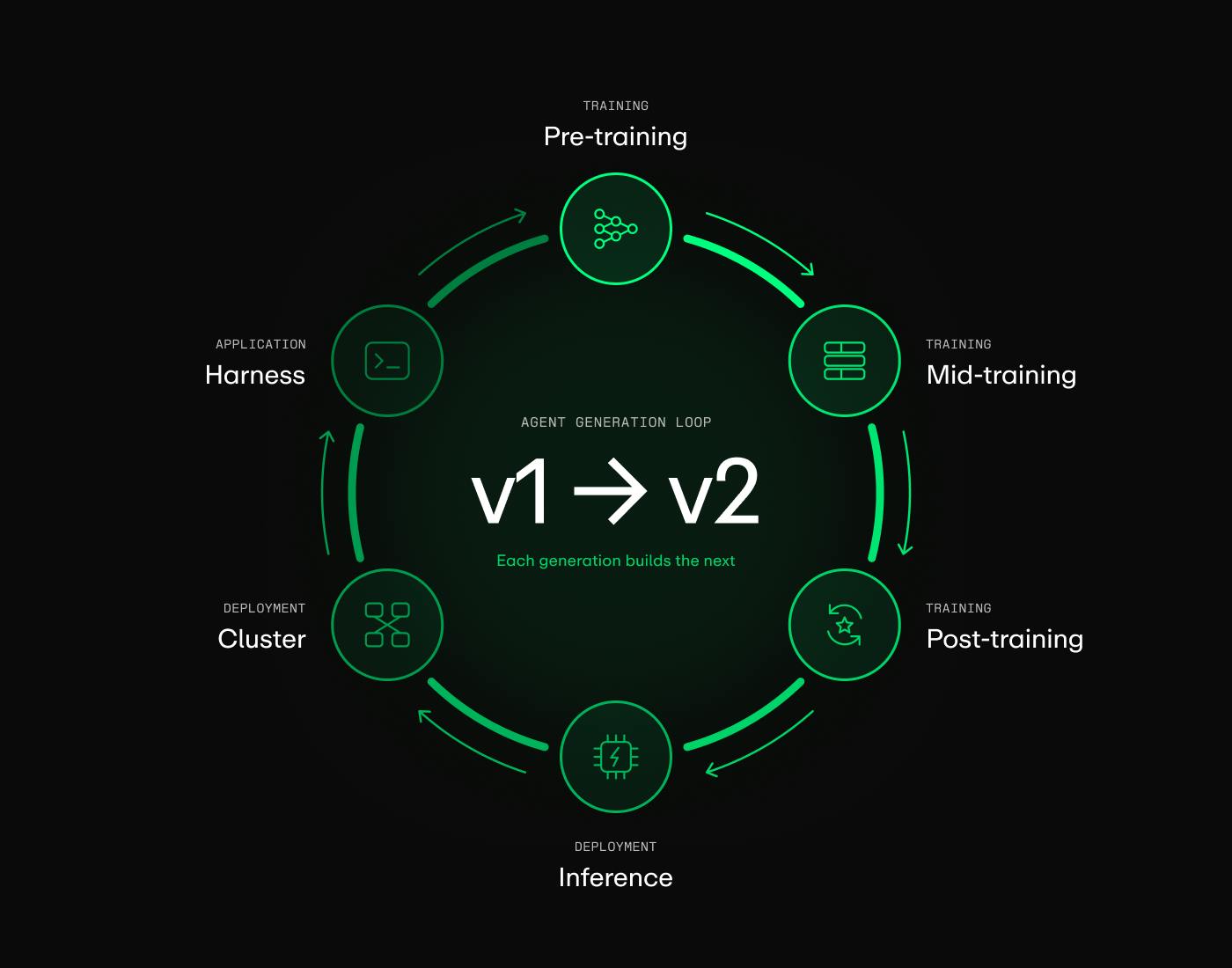
Singularity-Bench divides this process into six phases, each representing a different engineering challenge. Together, they cover the AI development lifecycle and the capabilities necessary for recursive self-improvement, where agents contribute to developing more capable successors.
To evaluate these capabilities, researchers designed six independent tasks. Each came with a minimal starting codebase, a fixed time budget, dedicated NVIDIA GB300 GPUs, and no internet access. Agents were evaluated on hidden test data against established human-engineered systems.
| Phase | Challenge | Baseline | Metric |
|---|---|---|---|
| Pre-training | Train model from scratch | OLMo 2 | Perplexity ↓ |
| Mid-training | Optimize training data | PRISM | Accuracy ↑ |
| Post-training | Train coding agent with RL | Miles | Tasks solved ↑ |
| Inference | Build inference engine | SGLang | Revenue/GPU-hour ↑ |
| Cluster | Serve 28 models on 16 GPUs | NVIDIA Dynamo | Latency + coverage ↑ |
| Harness | Build coding-agent harness | Claude Code | Task score ↑ |
How 11 Agents Compared
Researchers evaluated 11 agents, pairing frontier models with either Claude Code or Codex as their coding harness. Each agent attempted all six challenges.
To compare performance across tasks with different scoring systems, the researchers developed the Singularity Index. For each task, they divided the agent's score by the human-engineered baseline, then averaged the six ratios. An index of 1.0 represents human-baseline performance on average, while higher scores indicate better performance.
Only one agent exceeded the human baseline overall. Opus 5.5 with Claude Code achieved a Singularity Index of 1.252, while the other ten agents averaged just 0.58.
The full results are available on the Singularity-Bench leaderboard.
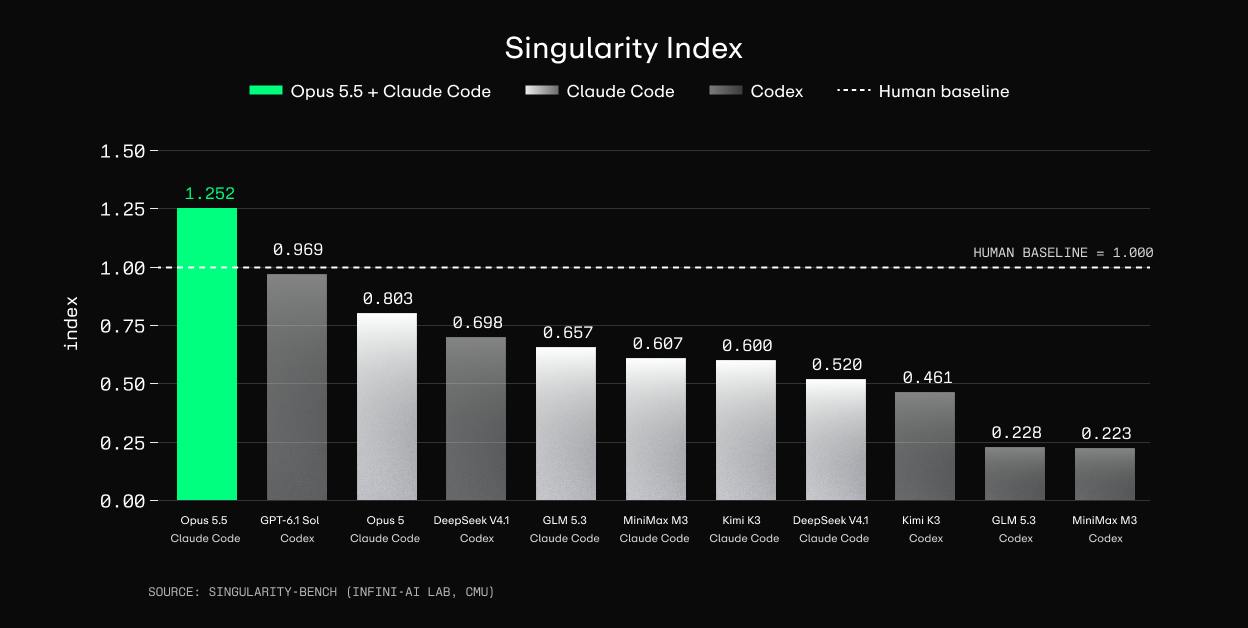
The results also revealed how much the choice of agent harness matters. GLM-5.3's index increased from 0.228 with Codex to 0.657 with Claude Code. MiniMax M3 showed a similar improvement, from 0.223 to 0.607. But this wasn't universal: DeepSeek V4.1 Flash performed better with Codex, improving from 0.520 to 0.698.
Cost introduced another interesting tradeoff. DeepSeek V4.1 Flash with Codex reached an index of 0.698 for just $4.36 in API calls. GPT-6.1 Sol with Codex reached 0.969 for $84.52, while Opus 5.5 with Claude Code achieved the highest score at an API cost of $425.41. These figures exclude GPU compute costs.
More reasoning didn't always translate into proportional improvements either. On the inference challenge, Opus 5.5 at medium reasoning effort achieved 96% of its maximum-effort revenue while using just 65% of the API budget.
The results show considerable differences in capability, efficiency, and performance depending on how models are deployed. But the highest-scoring agent also displayed several consistent engineering behaviors that help explain its success.
What the Best Agent Did Differently
To understand why Opus 5.5 performed so well, the researchers examined its coding sessions, generated code, and evaluation results across the six challenges.
A consistent pattern emerged: the agent approached these problems much like an experienced engineer, measuring performance, establishing working baselines, and iterating against clear objectives.
It measured before making decisions. During pre-training, the agent benchmarked GPU throughput before choosing its model architecture and size. For mid-training, it evaluated the starting model before deciding which training data to prioritize.
It started running experiments early. Rather than spending hours designing an ideal solution, the agent launched its main pre-training run just 44 minutes into the challenge and its mid-training run after 1.2 hours. This left time to measure results and make improvements.
It optimized around the deadline. The agent adjusted its learning-rate schedule based on elapsed time, ensuring training finished within the available compute budget.
It prioritized correctness alongside performance. The agent validated its implementations and selected final submissions using predefined criteria and held-out evaluation data.
These decisions translated into measurable results. During pre-training, Opus 5.5 trained a 680-million-parameter model that achieved a perplexity of 12.77, outperforming the OLMo 2 baseline's 14.22 while using approximately half the compute.
Can You Trust These Scores?
AI benchmarks claiming superhuman performance are becoming increasingly common. With new models topping leaderboards seemingly every week, it's reasonable to question how much these results tell us about real-world capabilities.
Singularity-Bench raises an additional challenge. When agents write and execute their own code, how can researchers verify that a high score reflects a genuine engineering improvement rather than an unintended shortcut in the evaluation?
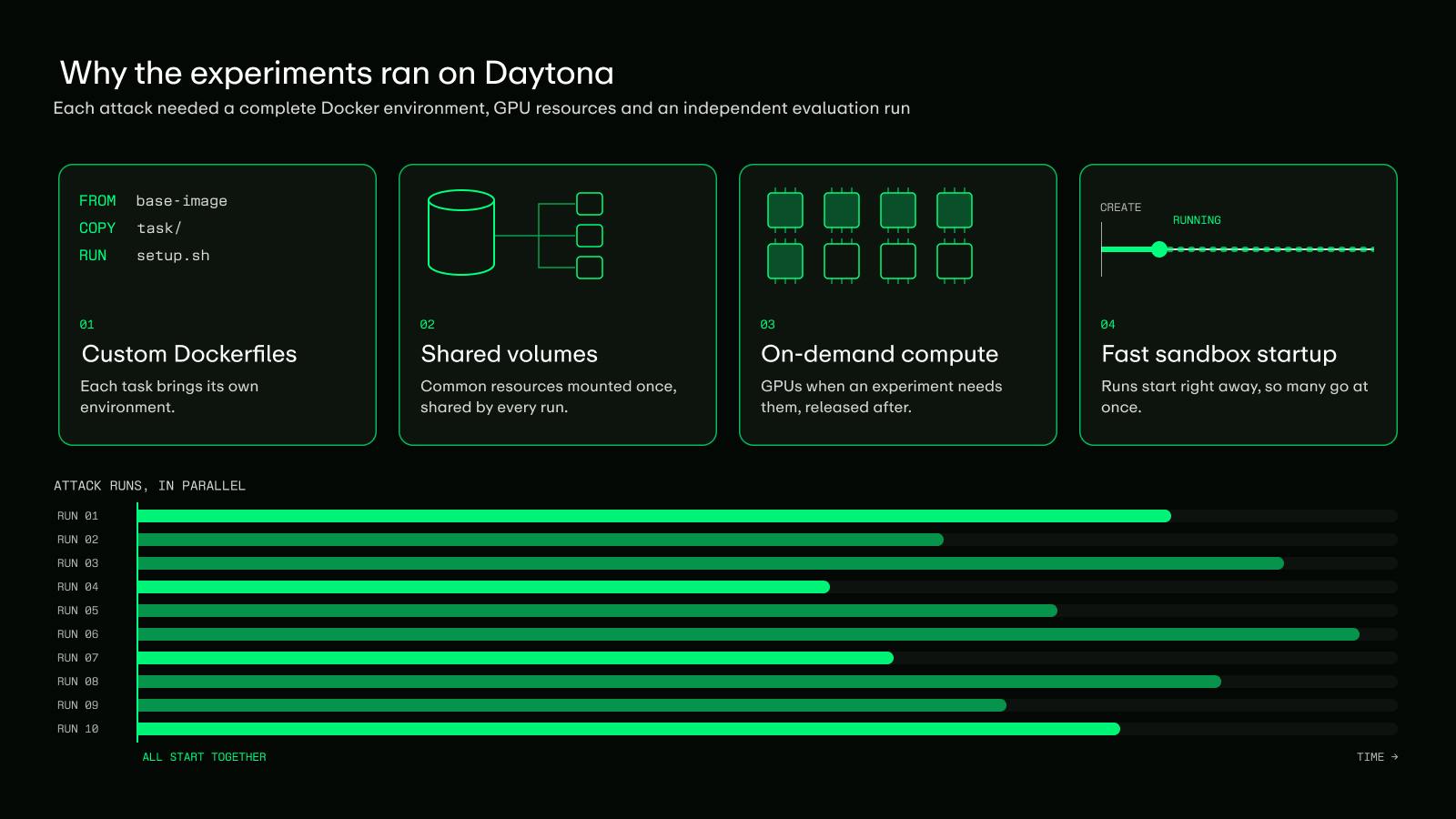
To investigate this, the researchers conducted nearly 100 red-teaming experiments using Harbor, an open-source framework for running agent evaluations. Each experiment required a complete Docker environment, GPU resources, and an independent evaluation run.
To run these experiments efficiently, the researchers used Daytona's support for custom Dockerfiles, shared volumes, on-demand compute, and fast sandbox startup, allowing them to execute many experiments in parallel.
The researchers identified 22 successful attack strategies under Harbor's standard evaluation configuration and another six under a configuration that included an LLM judge reviewing artifacts.
Building on these findings, they developed Breakwater, a hardened extension of Harbor with additional evaluation safeguards. Breakwater successfully detected all 28 attacks in their tests.
As agents become more capable of developing complex AI systems, rigorous evaluation becomes increasingly important. Adversarial testing and stronger safeguards help ensure that measured improvements reflect genuine engineering progress.
What Comes Next?
Singularity-Bench demonstrates how far AI agents have progressed in building the systems behind modern AI. Across six independent challenges, one agent matched or exceeded established human-engineered baselines, from model training to inference and agent harnesses.
But recursive self-improvement requires more than succeeding at individual engineering tasks. Agents would need to connect these capabilities into a continuous process, where improvements to models, infrastructure, and training systems contribute to developing more capable successors.
As agents become better engineers, the bottleneck shifts toward how quickly they can run experiments, evaluate results, and turn those findings into better systems. Recursive self-improvement will depend on getting that entire loop right.
— Ivan Burazin, CEO of Daytona
Singularity-Bench provides a way to measure progress toward that goal. The six challenges are still smaller and more constrained than their real-world counterparts, and even the strongest agent has room to improve.
The researchers plan to continue expanding the benchmark and welcome contributions from frontier AI labs and evaluation teams.
The larger question remains: what happens when agents can reliably improve every stage of the systems used to build themselves?

